

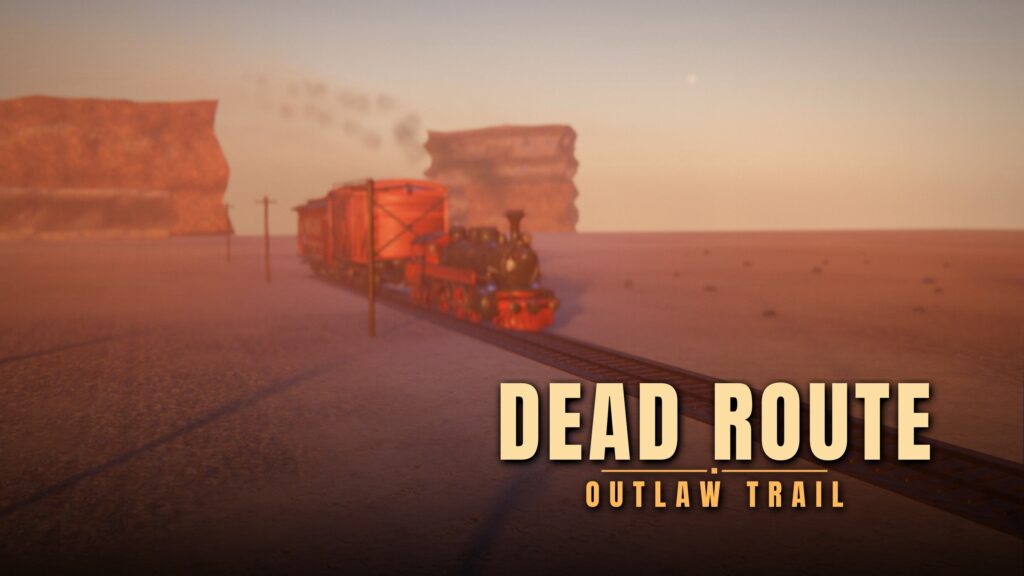
There is a particular kind of arcade magic that never really went away, even after the light-gun cabinets themselves mostly disappeared from high streets and arcades. It is the feeling of a fixed route, a gun in your hand, and a screen full of outlaws who need dealing with before they deal with you. Dead Route: Outlaw Trail is built entirely around that feeling, and it is out now on PC. London studio MediaVerse Labs has launched the first-person western rail shooter on the Epic Games Store for £8.79, with a Steam release coming soon, and it arrives as one of the most old-school propositions of the year: a ten-mission revenge campaign, a slow-motion dodge system, and choices that steer the story toward one of three endings.
For anyone who grew up feeding coins into arcade shooters, the pitch will sound immediately familiar, but the execution is deliberately modern. The camera moves along a fixed route through each level while the player handles the gun, aiming with the mouse and firing only at whatever sits beneath the crosshair. Enemies give a visible or audible warning before they shoot, so a careful player can always react in time, and the game rewards that care. It is a design that keeps the tension of the arcade original while removing the unfairness that used to eat your change.
A revenge story set in Dry Fork, 1884
The campaign opens in the frontier town of Dry Fork in 1884, where the local sheriff has hanged the hero’s brother on the orders of a railroad company that wants the land at any cost. Armed with a revolver, a horse and a list of names, the hero sets out after the men responsible, working through one gang at a time until he reaches the mansion of the man who gave the order. It is a classic western setup, and the game leans into it: a lone rider, a corrupt company, and a trail of gunfights that ends at the top of the food chain.
That trail runs through saloons, canyons, mines, a cattle ranch and a fortified town, and the game keeps changing how the action is delivered. Some sequences play out as gunfights on foot, others as horseback chases, mine-cart rides, or battles fought on the roof of a moving train. The variety matters, because a rail shooter lives or dies on whether the next stretch of track feels different from the last one, and Dead Route is clearly built to keep surprising the player with a new backdrop or a new way of moving through it.
Dead Time, cover, and outlaws who think
The headline mechanic is Dead Time, a slow-motion mode that slows the world down, shows incoming bullets in flight, and lets the player move out of their path. Used well, it turns a moment that would have been a cheap hit into a deliberate dodge, and it gives the game a tactical layer that the old arcade cabinets never had. The player can also duck behind cover to avoid fire and reload, then pop back up to shoot, which adds a rhythm to every encounter: expose yourself, take your shots, and know when to disappear again.
Trigger discipline matters, too. Innocent people appear in many encounters, and hitting one costs points and never counts as a kill, so spraying at the screen is a quick way to a bad grade. The arsenal is small but purposeful, with three weapons that each handle differently: a six-shooter for general work, a shotgun for close quarters, and a lever-action rifle for long shots. Learning when to switch between them is part of the skill curve, and it keeps the gunplay from settling into a single comfortable pattern.
The outlaws, meanwhile, are not simple pop-up targets. Gangs flank the player, keep heads down with suppressing fire, call for reinforcements, and scatter when their leader falls. That behaviour is what makes the encounters feel like fights rather than shooting galleries, and it is also what makes Dead Time and cover genuinely useful instead of decorative.
Bosses that fight dirty
Each chapter ends with a gang leader who has a signature trick, and the game is upfront that these fights are patterns to learn. One hides behind a hostage, another fires from a marksman’s nest high above the street, and another sprays the area with a fan of hot lead. Players who rush in usually do not last long, which is exactly the point: the bosses are designed to punish impatience and reward observation, in the same way the best arcade boss fights always were.
Choices, honour and fear
What sets Dead Route apart from a straight arcade throwback is its choice system. At key moments the game stops for a short cinematic decision, and the consequences are deliberately unlabelled. Sparing a wounded outlaw might earn a warning about an ambush ahead, while finishing him brings a bigger reward and no warning. Every decision adds to the hero’s honour or fear, and that reputation changes dialogue, allies, and ultimately which of the three endings the player reaches. No option is marked as the right one, and each choice shows its consequence within a couple of minutes, so the player always understands what their mercy or their ruthlessness just bought them.
That reputation system gives the campaign a reason to be played more than once, and the scoring systems reinforce it. Every mission is scored and graded from C to S based on accuracy, headshots and hostages saved, and an Arcade mode is designed for high-score runs. Three difficulty levels range from a forgiving setting for newcomers to Gunslinger for experienced players, and achievements reward perfect runs, well-timed dodges, and finding all three endings.
Presentation, accessibility and the road ahead
The game is fully voiced in English and Spanish, with subtitles, and it includes a solid set of accessibility options: a colour-blind mode, key rebinding, toggles for screen shake and flashes, and adjustable subtitle size. Those are the kinds of features that make a game like this playable for a much wider audience than the arcade originals ever managed, and they suggest a studio thinking carefully about who gets to enjoy the experience.
On the technical side, Dead Route: Outlaw Trail runs on Windows 10 and 11 (64-bit) with 8 GB of RAM and a DirectX 12 graphics card with 4 GB of video memory, and it needs 2 GB of storage. It is rated PEGI 18. MediaVerse Labs is an independent PC games studio based in London, founded in 2023 and operated by Eager Dragon Publishing, and the studio sells its games as one-time purchases with no ads and no tracking, which is a welcome stance in a market full of live-service hooks.
It is a crowded week for PC launches, and Dead Route sits comfortably alongside them. If you want another new PC release to keep an eye on, Blastheim launched this week as a second-screen action RPG unveiled by Path of Exile streamer Zizaran, while Blacksmith Master has just hit its complete 1.0 form. Racing fans, meanwhile, should check out Assetto Corsa Rally and its huge 0.7 update. But for players who miss the light-gun era, Dead Route: Outlaw Trail is the one to watch: a western that understands the arcade, rebuilds it for the mouse, and then gives the player real reasons to ride the trail more than once. More information, the trailer and screenshots are available on the official site. Source: MediaVerse Labs via GamesPress.
Follow Proven Gamer: X/Twitter | Facebook | Bluesky | Twitch | YouTube | Patreon | TikTok | Instagram | Threads | Discord